Agentic Development Life Cycle (ADLC)

Problem
Ad-hoc ticket work with no specification gate and no traceability.
Approach
A phase-gated pipeline — proposal, an agent-ready specification, a governance and vetting gate, then an EPIC delivery loop that runs spec, plan, tasks, agent implementation, integration, verification and review to done — with mandatory human approval at every transition, and supervised maintenance and handover after feature complete.
Outcome
Qualitative — multiple teams converted to spec-driven development; every engineer trained in context engineering
Most "AI in the SDLC" stories are about generating code faster. This one is about what has to be true before generation is safe: a proposal, an agent-ready specification, a governance and vetting gate, and a human approving every phase transition. Only then does the EPIC delivery loop run — spec, plan, tasks, agent implementation, integration, verification, review, done — and the work carries on into supervised maintenance and handover once the feature is complete. The generation step is the easy part.
What I did
- The practice, authored and rolled out org-wide. Proposal → Agent-ready Spec → Governance & Vetting → EPIC Delivery Loop (Spec → Plan → Tasks → Agent Implements → Integrate → Verify → Review → Done) → Feature Complete → Supervised Maintenance → Handover, with human approval at every transition. Trained every engineer in context engineering; multiple teams converted to spec-driven development.
More work
 AI Tooling
Agentic Delivery Harness
A delivery harness that drives an approved requirements document to shipped code through phase gates, and runs the same way on any coding agent.
 AI Tooling
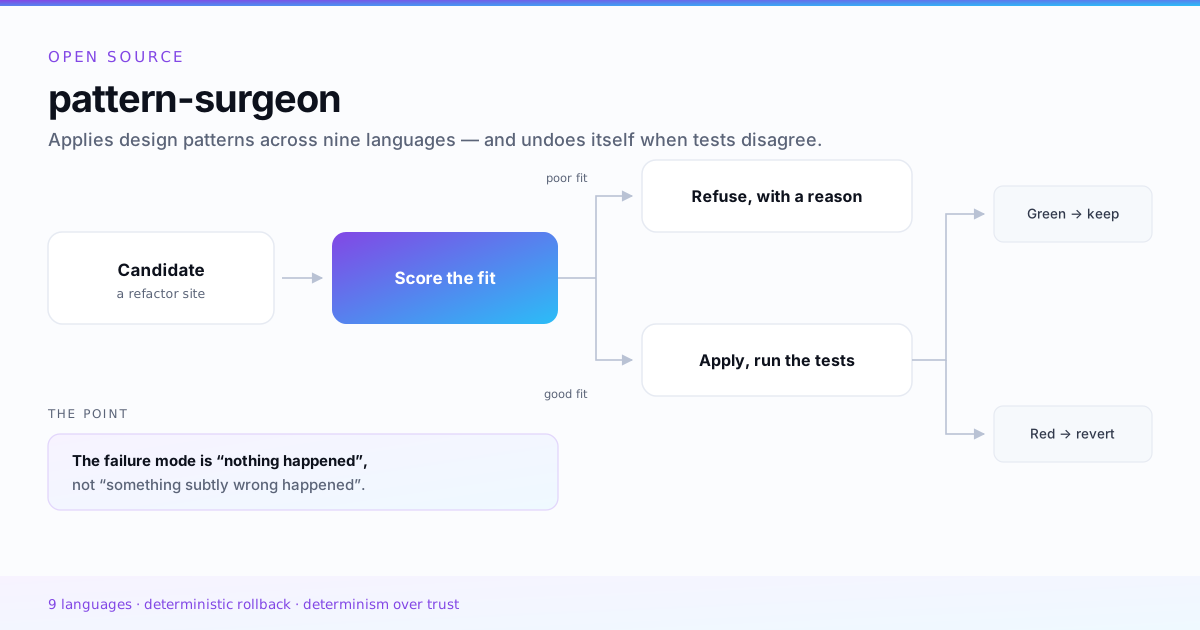
pattern-surgeon
A refactoring agent that applies design patterns across nine languages and undoes itself when the tests disagree.
 Security
CyberWise
A security awareness and phishing simulation platform that banks run against their own staff to find out who is at risk, and then train them.
Building something that needs this kind of engineer?
Hiring, contract, or an architecture problem — tell me the shape of it and I’ll come back with something specific.