Agentic Delivery Harness

Problem
Agentic delivery practice tends to couple to whichever vendor’s tool the team adopted, so the practice dies when the tool changes.
Approach
One rule set, skill registry, and task queue, built model-agnostic from the start, with generated work peer-reviewed by a different model before an independent QA gate.
Outcome
Qualitative — runs identically on Claude Code, Codex CLI, OpenCode, and Cursor
4 agent platforms supported
The tooling behind the ADLC, published separately so the practice survives a change of vendor. A proposal goes in; an agent-ready specification, a governance and vetting gate, and QA-gated EPIC delivery come out — with a human approving every phase transition. It runs the same on Claude Code, Codex CLI, OpenCode, and Cursor, and work generated by one model is reviewed by a different one before QA sees it. Skills are authored on top of it, pattern-surgeon among them.
What I did
- The tooling, open-sourced. One rule set, skill registry and task queue running identically on Claude Code, Codex CLI, OpenCode and Cursor. Generated work is peer-reviewed by a different model before an independent QA gate. Skills are authored on top of it — including pattern-surgeon, a design-pattern refactoring skill covering nine languages.
More work
 AI Tooling
Agentic Development Life Cycle (ADLC)
The engineering manifesto that replaced ad-hoc ticket work at my company with a phase-gated, human-approved delivery pipeline.
 AI Tooling
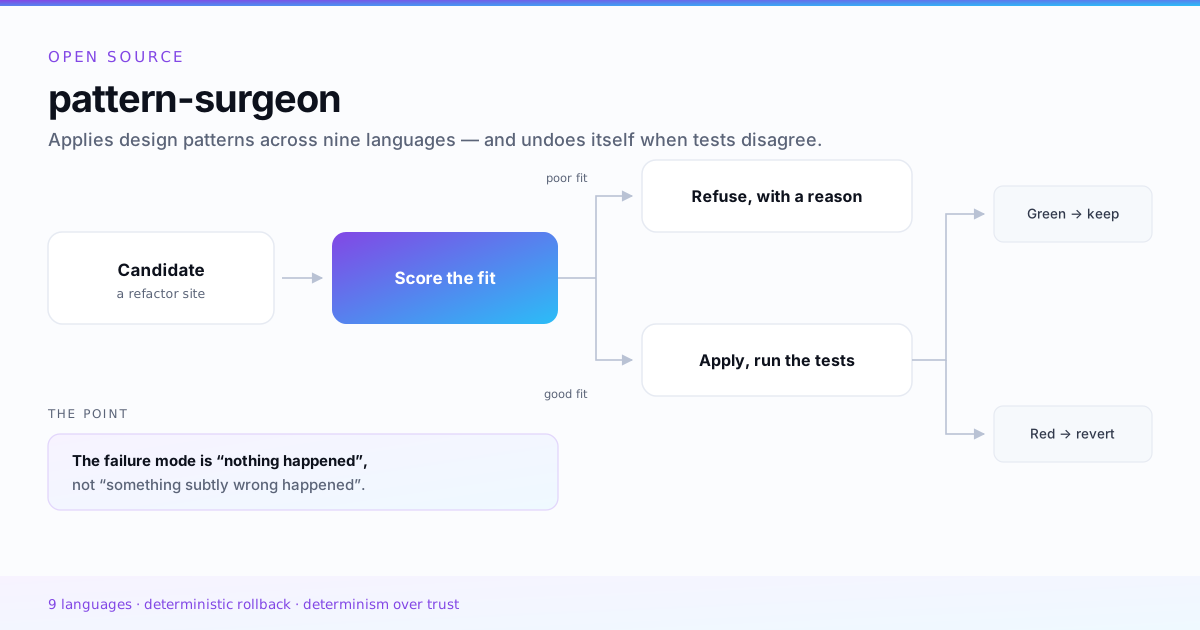
pattern-surgeon
A refactoring agent that applies design patterns across nine languages and undoes itself when the tests disagree.
 Security
CyberWise
A security awareness and phishing simulation platform that banks run against their own staff to find out who is at risk, and then train them.
Building something that needs this kind of engineer?
Hiring, contract, or an architecture problem — tell me the shape of it and I’ll come back with something specific.